AI Support Triage — a production agent
An agent that took over support-ticket triage: it classifies and routes each ticket, then a gated investigator agent reads the live system, code, telemetry, and docs to draft the fix and the reply — with a human approving every action.
What I built
I spearheaded an AI agent that took over support-ticket triage — work that was consuming roughly one in seven hours of the team's time. It runs the full loop in production: classify and route the ticket, investigate the live system, then draft the fix and the reply — with a human approving every action.
How it works
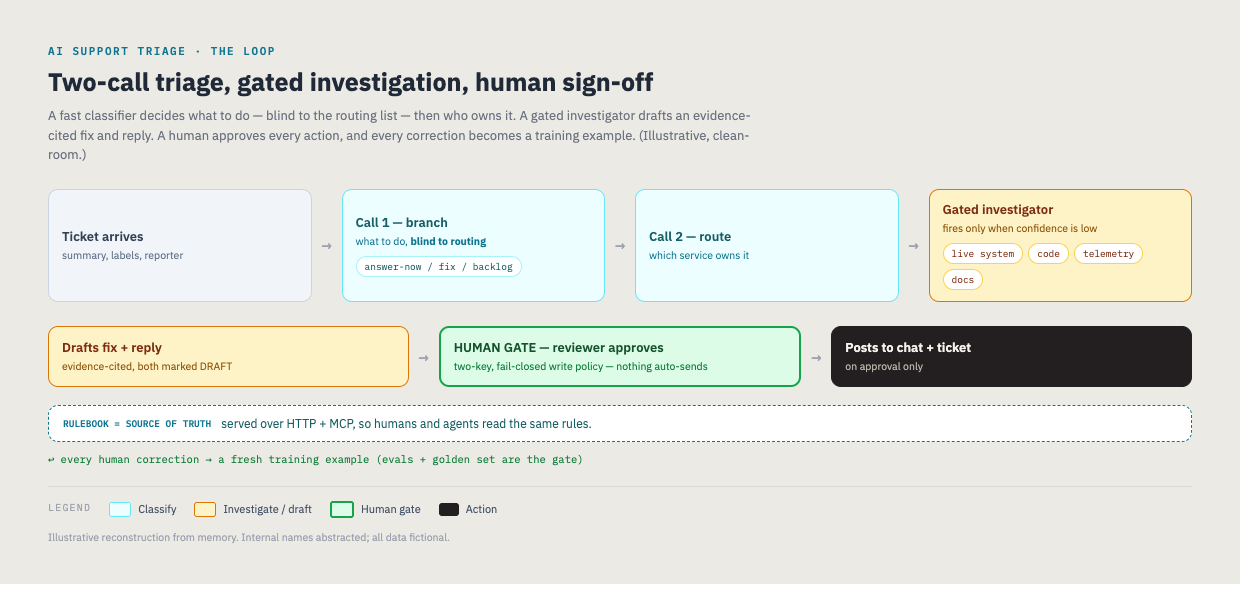
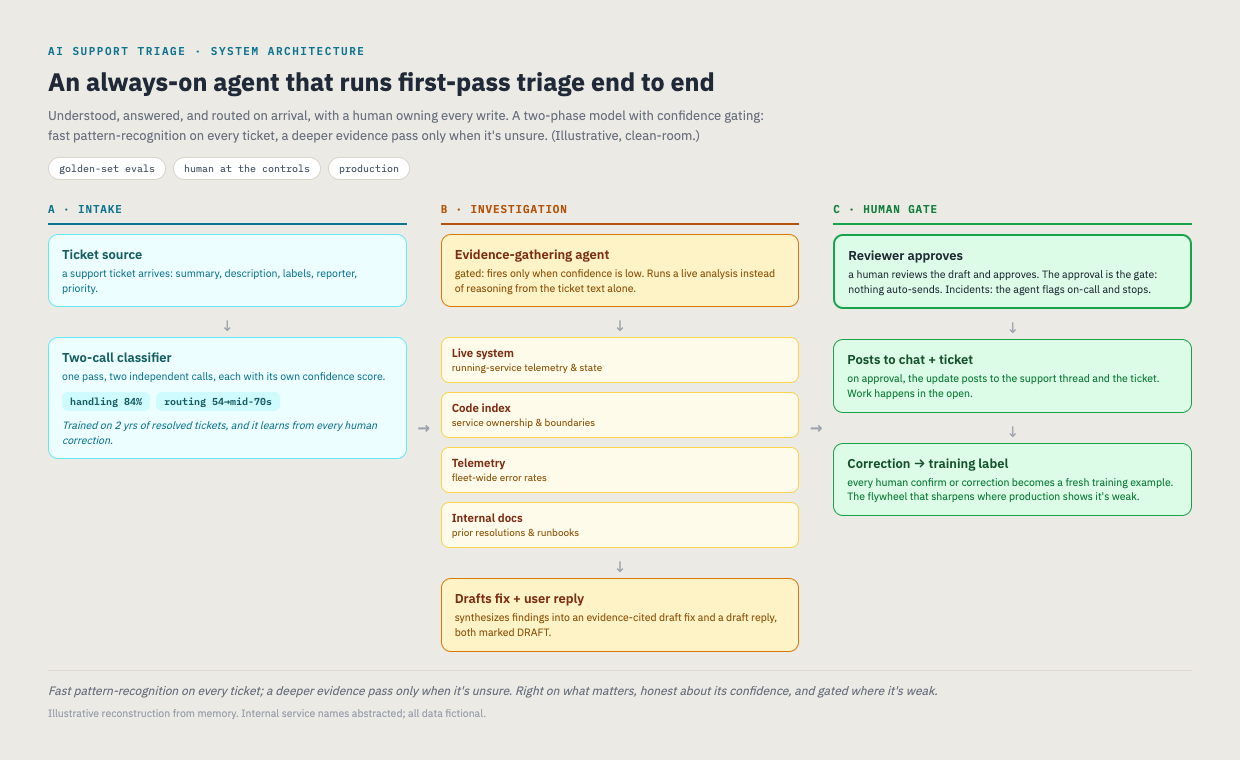
A two-call classifier decides what to do first — deliberately blind to the routing list — then, separately, who owns it. A gated investigator agent reads the live system, code, telemetry, and docs to draft an evidence-cited fix and reply. A person approves every call before anything goes out; it was trained on two years of resolved history and improves with every correction.
How I built it
Architecture: a rulebook is the single source of truth, served over both HTTP and MCP so humans and agents read the same rules. A two-key, fail-closed write policy gates every external write (chat / tickets) behind a human/agent switch — nothing auto-sends. The agent runs as a looped Claude-CLI process against that tool surface (FastAPI + MySQL + Docker).
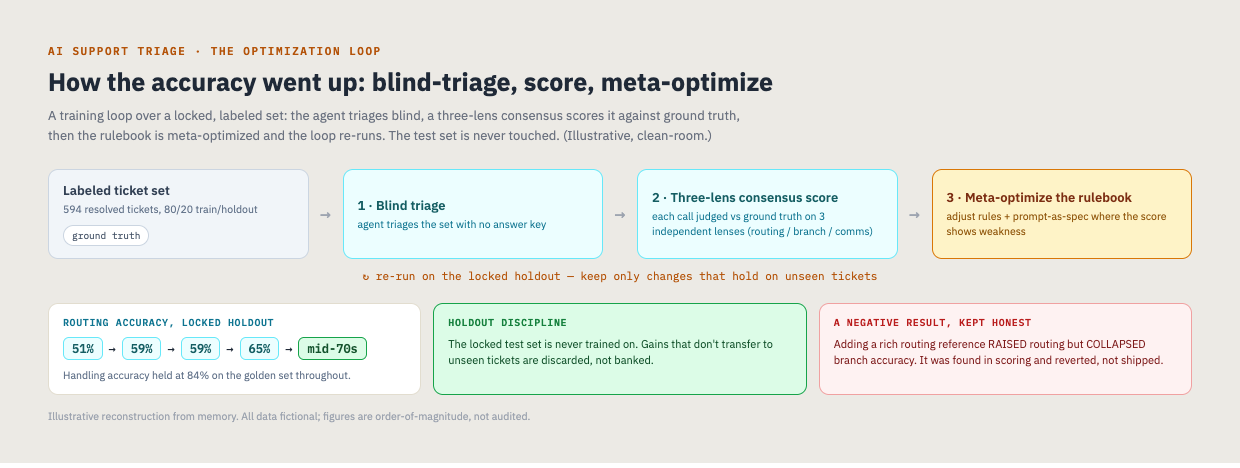
How I got the accuracy up: a persona pod supplied routing expertise and independent judging, and I ran an optimization loop — blind-triage a locked set, score each call with a three-lens consensus against ground truth, then meta-optimize the rulebook — on 594 labeled tickets (80/20 train/holdout, the test set kept untouched). A negative result (adding a rich routing reference raised routing but collapsed branch accuracy) was found and reverted rather than shipped.
The whole thing is eval-driven: a golden set is the gate, and every human correction becomes a fresh training example.
Questions this project answers
How do you know an AI agent is actually good, and not just plausible-sounding? Against held-out ground truth, not vibes. I built a golden set of previously-resolved tickets the agent had never seen and measured handling accuracy against the known-good resolutions (~84%); routing accuracy improved from 54% to the mid-70s on a locked holdout. Every human correction during the beta became new evaluation data, so quality was tracked continuously. Operationally I instrument per-turn cost, latency, error rates, and traces, so failures are diagnosable.
When an agent is confidently wrong, what stops it from doing damage? A human sign-off gate on every external write, two-key and fail-closed, so nothing auto-sends. Autonomy expands only as the eval numbers earn it, an observe-then-enforce rollout rather than turning it loose. The hard part was never the model, it was trust: making the agent's behavior legible, catching the cases where it was confidently wrong, and feeding corrections back in.
Is this real production AI, or a proof of concept? In production. It ran the full loop, classify, investigate, draft the fix and the reply, in a team-wide, month-long beta, reclaiming roughly one in seven hours of the team's time with a human in control.
How do you keep an agent's cost and latency in check? The expensive part is gated. The investigator only fires when the classifier's confidence is low, so the deep evidence pass runs on the minority of tickets; the common path stays a cheap two-call classification.
Results
- 84% handling accuracy on golden-set evals.
- Routing accuracy climbed from 54% to the mid-70s on a locked holdout.
- Reclaimed roughly one in seven hours of team time, with a human in control.
- Reached a team-wide, month-long production beta running the full loop.
Skills
AI / Agentic
| LLM agent design | Designed the classify → investigate → draft loop that runs triage end to end. |
|---|---|
| Evals / golden-set | Built a golden set of resolved tickets; measured ~84% handling accuracy against it. |
| Optimization loop | Blind-triage → three-lens scoring → meta-optimize; routing 54% → mid-70s on a locked holdout. |
| MCP servers | Served the rulebook over HTTP + MCP so humans and agents read the same rules. |
| Human-in-the-loop gate | Two-key, fail-closed write policy on every external action; nothing auto-sends. |
Frontend
| Review / approval UI | The surface where a human approves or corrects each drafted action. |
|---|---|
| Agent console | Operator console for running and observing the agent loop. |
Backend / Infra
| Python · FastAPI | The rulebook and tool services the agent runs against. |
|---|---|
| MCP tool surface | Exposed live system, code, telemetry, and docs to the investigator agent. |
| MySQL · Docker | Persistence and containerized deploy for the self-hosted agent loop. |
| Gated integrations | Chat and ticketing writes routed through the fail-closed policy. |
Leadership
| Ambiguous mandate → production | Turned an open-ended 'use AI for support' brief into a shipped, measured system. |
|---|---|
| Trust model | Defined the observe-then-enforce, human-in-the-loop rollout the team adopted. |
| Measured bar | Made golden-set accuracy the gate for expanding autonomy. |